Client Survey Guide: Better Questions, Better Results
A Guide to Survey Design in Oomiji
Oomiji's AI analysis, segmentation, and engagement tools are only as powerful as the questions behind them. This guide gives you working examples organized by goal, along with notes on what makes each question effective and what to avoid.
⚠️ A note on question types: open-ended questions produce the richest language for AI analysis and segmentation. Scaled and closed questions are useful for benchmarking and sorting, but they are not substitutes for open-ended responses. Where both appear in a section, lead with the open-ended questions.
Quick Links
Sample Questions: Understanding Why
Sample Questions: Identifying Advocates
Sample Questions: Surfacing Barriers
Sample Questions: Segmenting by Interest
Sample Questions: Reengaging Customers
Sample Questions: Satisfaction Beyond the Score
How many questions to ask?
Companies often have a long list of questions they want to ask their customers. On Oomiji, you can do that but don’t ask them all at once. People get survey fatigue at 8 to 12 questions.
Asking three or four questions at a time will get you a much higher response. The great thing about Oomiji, is that you can ask another three or four in the next month or quarter and continue to learn more about your customers.
When composing questions, the question to ask yourself is: 'What information is most important to marketing and selling my product?’ If the information is of mild interest but not key to your sales, save it for another time.
Net Promoter Score Questions
[ see Understanding Satisfaction and NPS in Oomiji ]
NPS questions are a great way to start and get you a surprising amount of information by using both Oomiji’s segmentation capabilities and one-click aggregate analysis. As NPS consists of only two questions, one closed-ended and one-open ended, you’re likely to get a much higher response and you’ll learn perceptions of your product or service directly from your customers. It’s also a great way to get clues to attracting more high lifetime value customers.
One-Click Aggregate Analysis
Both the Insights and Satisfaction sections of the platform offer One-Click Aggregate Analysis that will quickly analyze your survey results and provide descriptions of Key Consumer Segments, Trends and Patterns, Verbatim Analysis, and Actionable Recommendations. This feature will save you time and money in analyzing and interpreting customer insights for better planning.
Sample Questions
[ see Choosing and Configuring Question Types ]
Goal 1: Understanding why customers buy
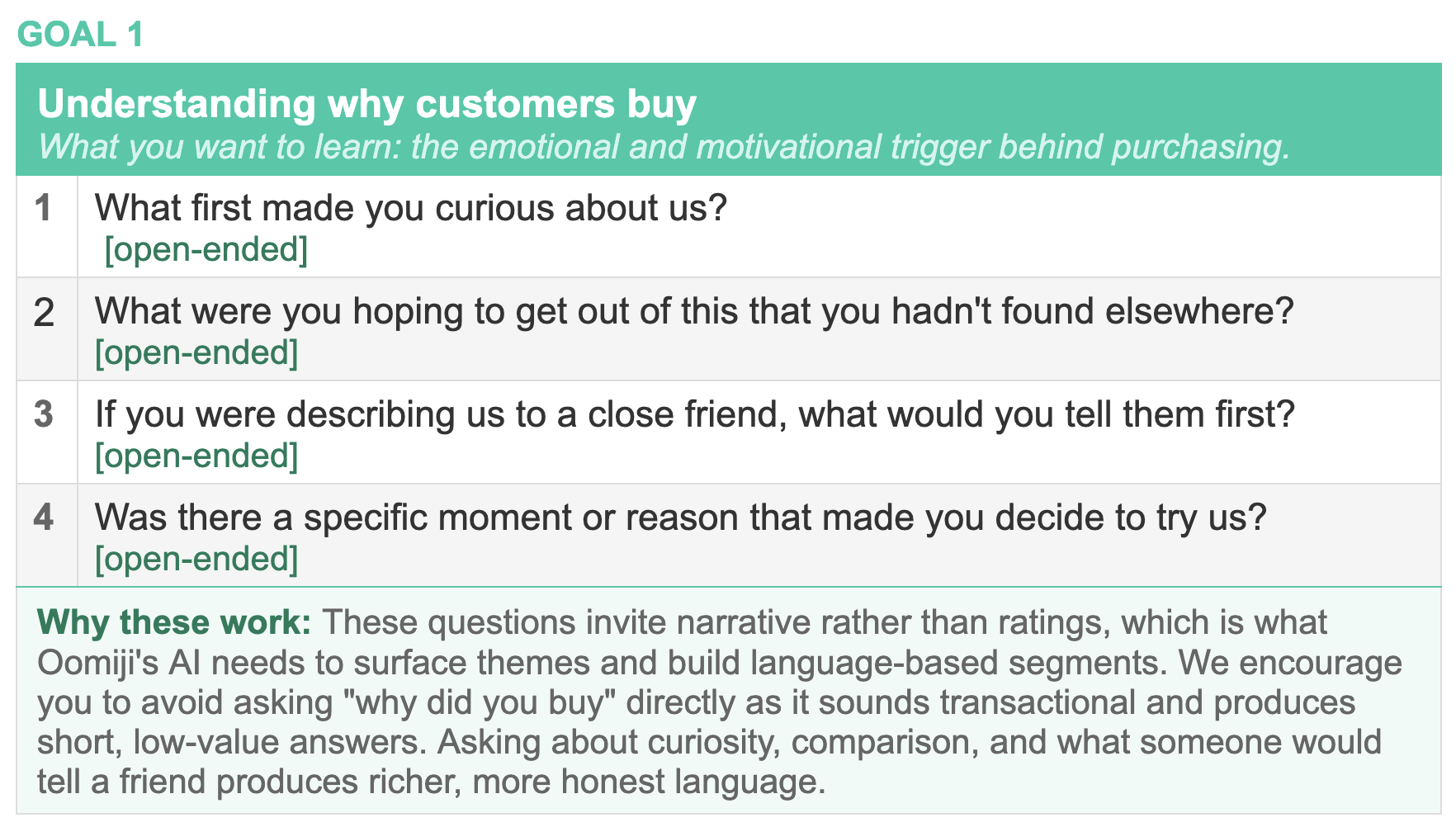
Goal 2 : Identifying brand advocates and promoters
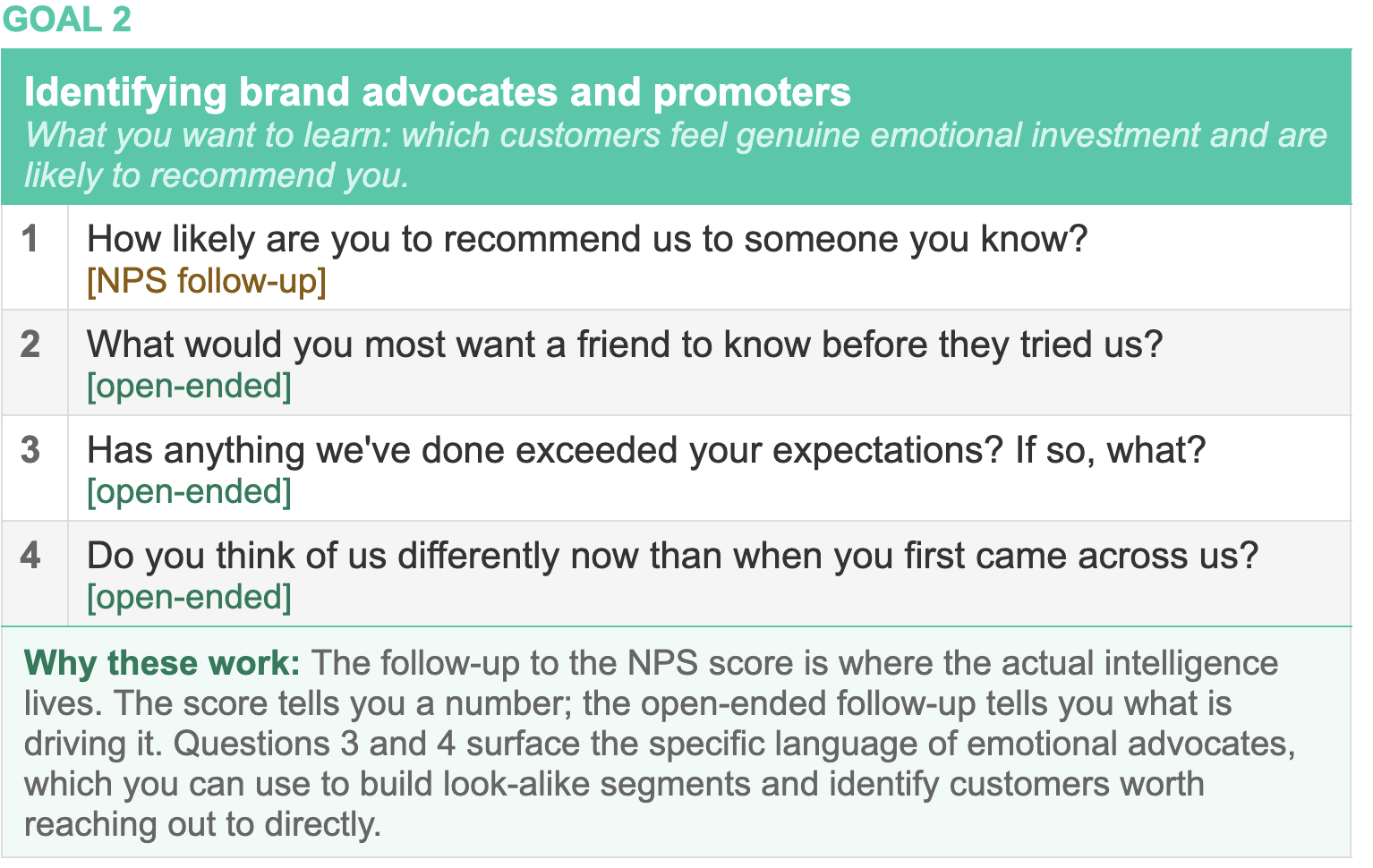
Goal 3 : Surfacing objections and barriers
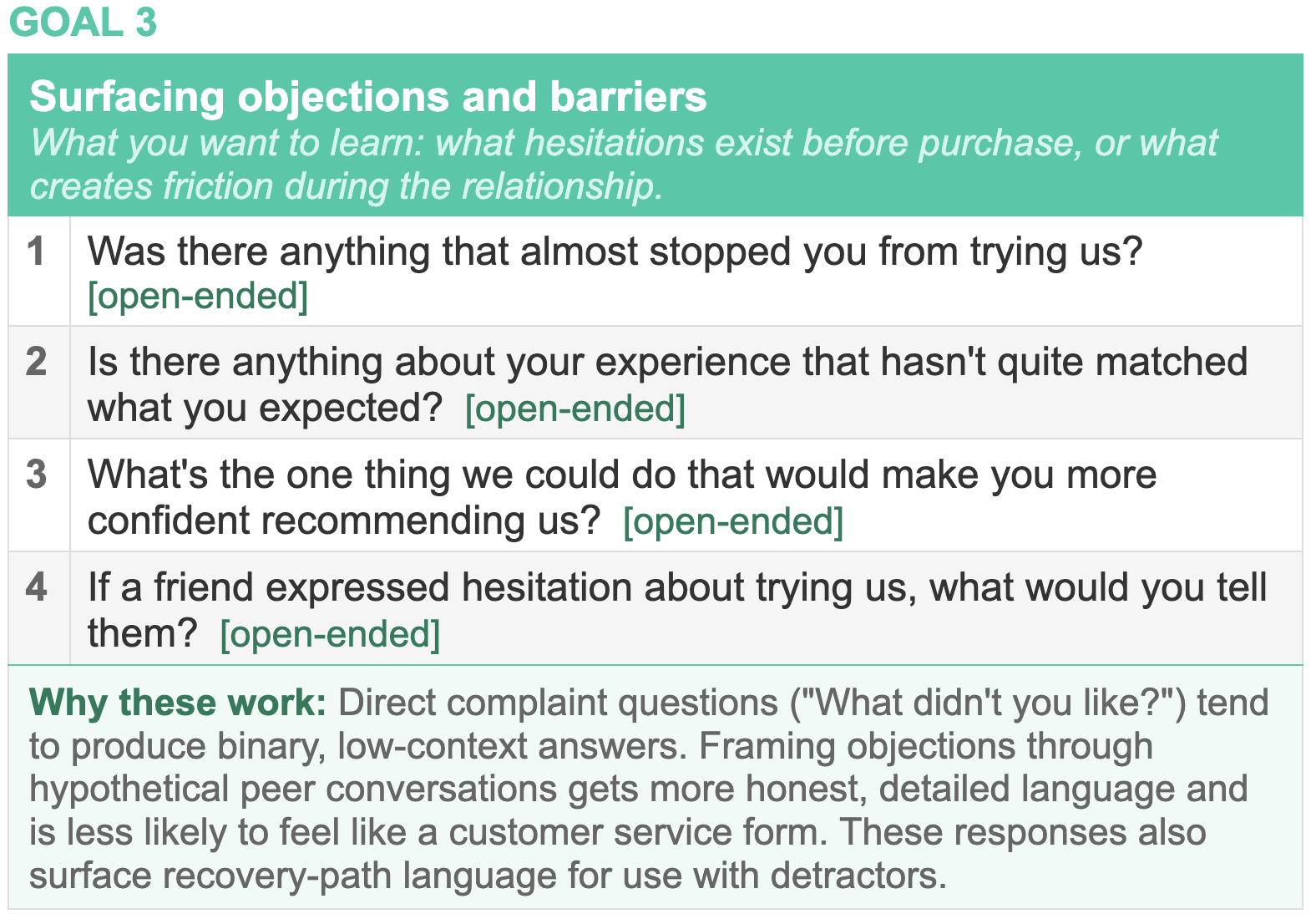
Goal 4 : Segmenting by interest and lifestyle
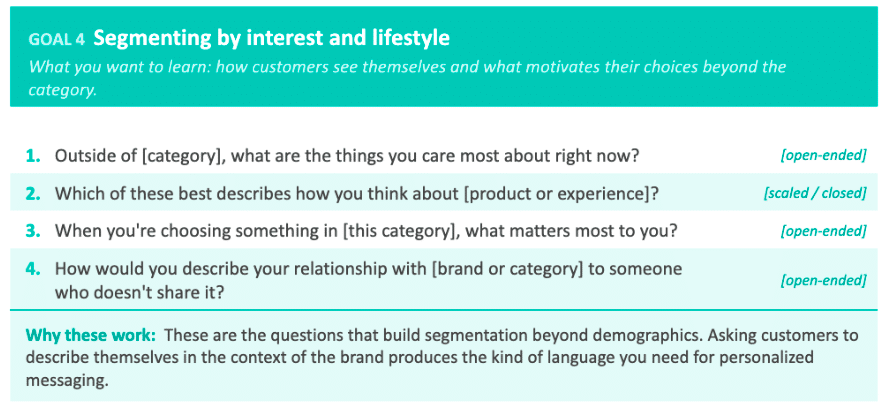
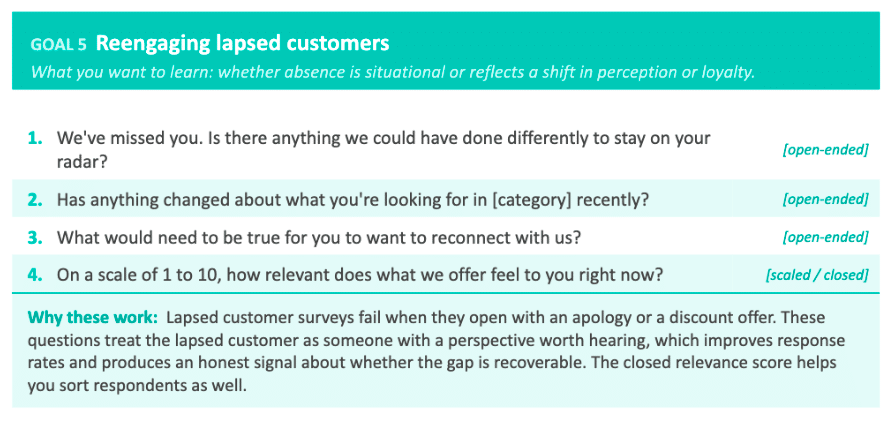
Goal 5: Reengaging lapsed customers
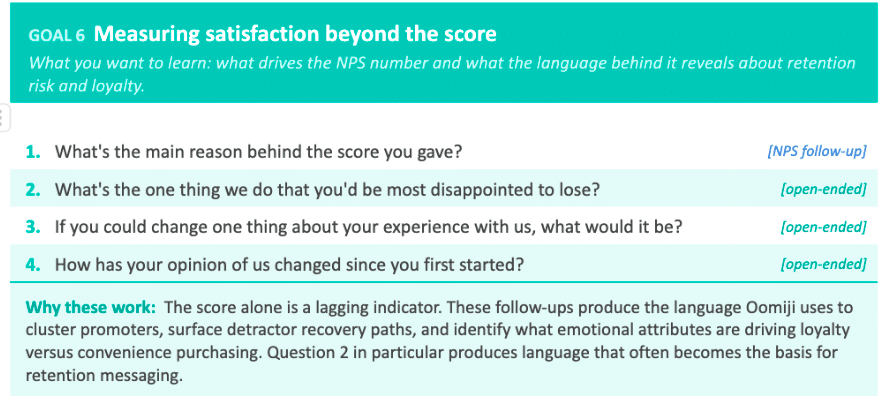
Goal 6: Measuring satisfaction beyond the score
What to Avoid
The most common ways clients degrade their own data before analysis even begins.
|
COMMON MISTAKE |
WHY IT MATTERS |
| Leading questions |
“Don’t you think our service is excellent?” primes the respondent toward agreement. You get confirmation, not honest signal. Oomiji’s AI will surface the language you fed them, not what they actually think. |
| Double-barreled questions |
“Was our product high quality and easy to use?” asks two things at once. If the answer is yes to one and no to the other, the response is useless. Each question should have exactly one variable. |
| Too many questions |
Surveys longer than 5 to 7 questions see sharp drops in completion rate. Oomiji tracks per-question completion, so you will see exactly where respondents drop off. Shorter surveys with better questions outperform long ones with mediocre ones. |
| Only asking closed questions |
Scaled and multiple-choice questions can tell you where sentiment lands, but they cannot tell you why. Open-ended responses are where the language for segmentation, messaging, and AI analysis comes from. A survey with only closed questions produces sorted data, not intelligence. |
| Vague or generic phrasing |
The more specific the question, the more specific and usable the response. “How was your experience?” is so broad it produces low-effort, meaningless answers. Replace category words (“experience,” “service,” “product”) with concrete references to what actually happened. |
| Asking what you already know |
Use surveys for what you cannot get any other way: motivations, perceptions, emotions, and intent. If you already have demographic or purchase data on a customer, don’t use survey space asking for it again. |
A useful test before sending any survey: read each question aloud and ask whether a thoughtful person could give you a genuinely surprising answer.
If the range of possible answers is obvious or narrow, the question needs work.